
You’ve probably come across publications and social media posts declaring agentic AI as the next frontier of artificial intelligence. These agents are said to perform tasks that require decision-making and collaborate with each other. For example, one agent might tackle research work while another takes the insights and actions them.
Now, how much of this is hype, and what can agentic AI really do—at present?
We answer these questions in this blog. We also cover some key benefits of AI agents and what enterprises must consider before deploying them.
What is agentic AI?
Agentic AI refers to AI systems that operate with minimal human oversight. These systems use advanced techniques like machine learning, deep learning, and reinforcement learning to process data, recognize patterns, and continuously improve their performance. The goal is to develop AI that can complete tasks and solve problems autonomously.
AI “agents” can be built using different technologies, or even a combination of them. For example, one agent might be powered by a large language model (LLM), another might specialize in well-searching and pulling information from internal systems, and a third could do both.
To understand why agentic AI is gaining attention, consider a typical LLM, which generates responses based on its training data. Say you ask it about popular travel destinations to visit; it will provide answers based on past data.
But what if it could access real-time information?
Imagine an AI system that pulls the latest travel demand from Google Trends or checks live booking data. Instead of outdated suggestions, it could tell you which destinations are trending right now. That’s an example of an AI agent in action: gathering real-world data, making decisions, and providing up-to-date insights.
Here are two real-world examples of agentic AI:
Built on a specialized AI model called the computer-using agent (CUA), Operator automates common tasks like ordering groceries, filing expense reports, and making reservations. It interacts with websites the same way a human would: navigating menus, typing, and clicking buttons. Currently in research preview, Operator includes safeguards such as requiring user approval for sensitive tasks, ensuring the user stays in control.
Integrated into the Claude model, this feature enables the AI to interact with computer interfaces. It can perform tasks like scheduling appointments, filling out forms, and organizing files. Using reinforcement learning and contextual understanding, it efficiently completes multi-step workflows, making it a powerful digital assistant.
7 benefits of agentic AI for business
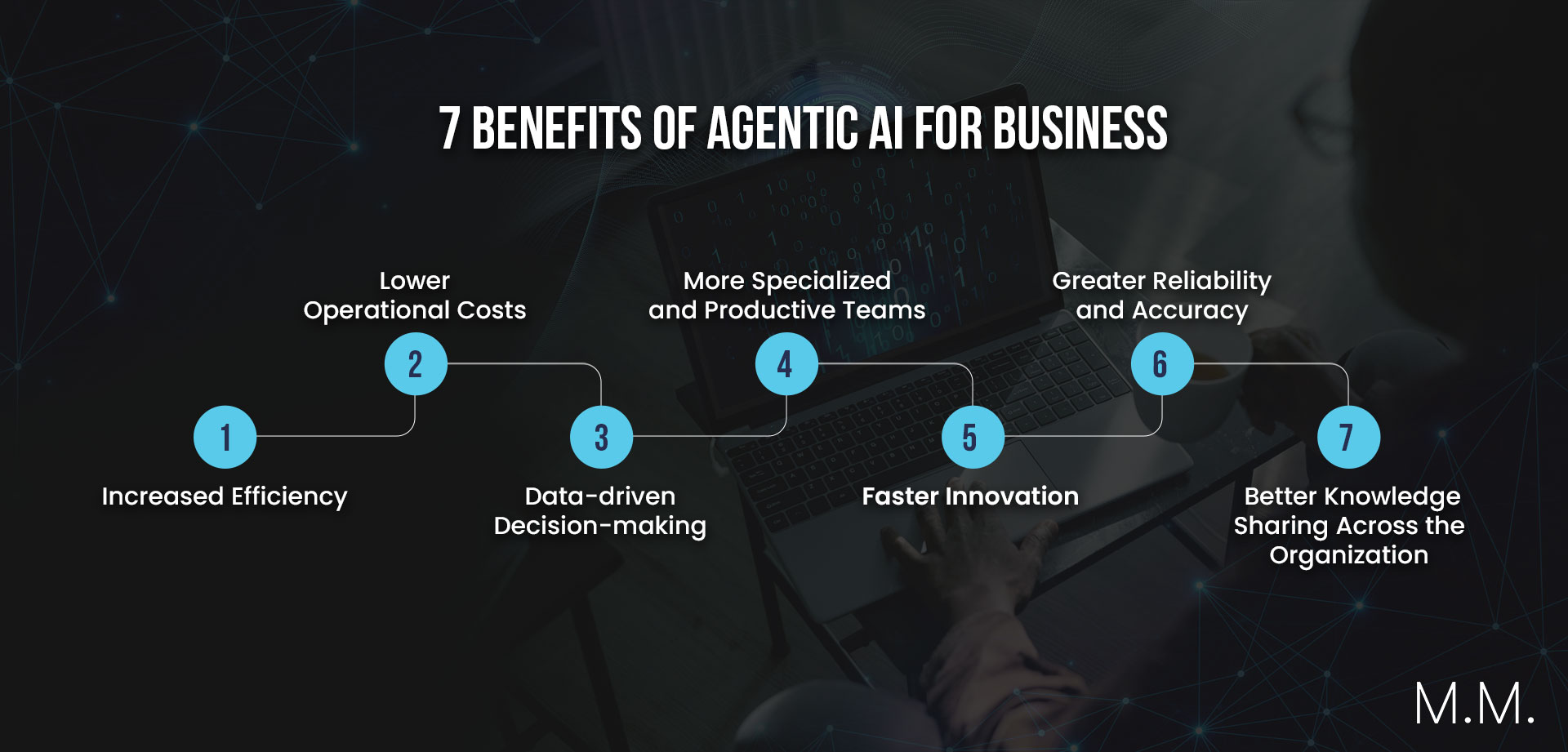
1. Increased efficiency
Agentic AI streamlines operations by automating complex, repetitive tasks that would otherwise require significant time and resources. This frees employees to focus on strategic initiatives that drive business growth. These AI systems also adapt to changing conditions in real time, keeping workflows optimized even in fast-paced industries.
2. Lower operational costs
By automating routine tasks and minimizing errors, agentic AI helps businesses cut operational costs. It optimizes resource allocation, allowing staff to tackle high-value work while AI handles repetitive processes. This improves cost efficiency and maintains consistent performance at a scale that would be difficult to achieve manually.
3. Data-driven decision-making
Agentic AI quickly processes vast amounts of data, identifying patterns and generating insights that support better decision-making. With real-time, data-backed recommendations, business leaders can make informed choices, even in dynamic environments.
4. More specialized and productive teams
By handling routine operational tasks, agentic AI lets employees focus on creative problem-solving, strategic planning, and other high-skill work. This leads to more engaged, productive teams and maximizes human expertise where it matters most.
5. Faster innovation
Agentic AI rapidly analyzes large datasets to uncover trends, identify opportunities, and suggest innovative solutions. For example, it can scan research papers, market trends, or experimental data to generate insights that drive product development and process improvements.
6. Greater reliability and accuracy
These AI systems continuously evaluate data sources and make decisions based on the most up-to-date information, reducing costly errors and improving accuracy. This consistency builds trust in AI-driven processes and ensures more reliable business operations.
7. Better knowledge-sharing across the organization
As agentic AI interacts with data and users, it builds a centralized knowledge base accessible across departments. This improves collaboration and decision-making by making valuable insights readily available to teams company-wide.
The enterprise problem: Why agentic AI isn’t ready for organization-wide deployment, yet
AI agents can operate autonomously but still rely on humans to set goals, choose the right tools, and organize their workflows. Unlike human employees, they struggle with ambiguity and cannot make assumptions when instructions are unclear. Every step of their process must be carefully planned, with clear decision points and contingency plans in case human intervention is needed.
This poses a challenge for enterprises. Traditional workflows often rely on human intuition, but AI agents need structured data and precise instructions to function correctly. For example, if an agent pulls information from a database, that data must be complete, properly formatted, and aligned with the agent’s capabilities. Missing or inconsistent data can lead to unreliable or incorrect outputs.
Another difficulty arises when workflows don’t proceed as planned. Unlike humans, AI agents struggle to adapt to sudden changes, which can cause inefficiencies or errors.
Accuracy is also a major concern. Small errors in AI-driven decisions can accumulate over time, leading to significant failures if not addressed. As AI models, especially LLMs, can sometimes produce incorrect or unpredictable outputs, continuous monitoring and error correction are essential. This adds another layer of operational complexity for businesses.
Defining clear goals is another hurdle. Many organizations assume their objectives are well-defined, but in reality, they often lack precision. This has long been a problem in areas like CRM and sales automation, where vague requirements lead to poor implementation. With AI agents, this issue becomes even more critical since they require specific, measurable goals to function effectively.
Finally, AI agents are still in the early stages of development. While research is advancing fast, many key techniques needed to make them more reliable (e.g., reinforcement learning, structured output generation) are not yet mature enough for large-scale deployment.
Solutions like retrieval-augmented generation (RAG), supervisory models, and process guardrails are helping to improve AI performance. However, technology alone isn’t enough. For AI agents to be widely adopted, businesses must also rethink how they design, document, and manage their workflows.
Key considerations for deploying agentic AI

Successfully deploying agentic AI requires careful planning to ensure transparency, control, and accountability at every stage. Here’s what organizations should focus on:
• Select a reliable AI model
Choose an enterprise-grade LLM capable of handling complex, real-world tasks. Look for models with built-in error correction to improve reliability and reduce risks. A strong AI model should also adapt over time, learning from past mistakes to take on increasingly sophisticated tasks.
• Establish clear orchestration
Define how AI agents and human teams will interact. Specify which tasks the AI will handle independently and which require human oversight. A well-structured orchestration system ensures seamless collaboration, transparency, and control over AI-driven decisions.
• Implement safety guardrails
Set clear boundaries for AI operations to minimize risk. Use models with built-in transparency to track decisions and flag actions that need human review. This is especially critical when handling sensitive data, legal matters, or high-risk scenarios.
• Design a strong tool architecture
Determine which systems the AI will interact with, such as databases, APIs, or external services. Create a standardized framework for integrating these tools. This enables secure, efficient data flow and minimizes errors caused by miscommunication between systems.
• Test thoroughly before deploying
Conduct rigorous testing before going live. Assess both functionality (to verify correct behavior) and stress tolerance (to measure performance under heavy loads). Use unit tests to validate individual components, scenario-based tests to address edge cases, and scalability tests to ensure the system can support future growth.
• Maintain human oversight for critical decisions
For high-risk tasks, AI should assist rather than replace human judgment. AI can provide insights and automate processes, but final judgments in critical areas should remain in human hands.
• Continuously monitor and adapt
Regularly review AI performance to identify weaknesses and areas for improvement. This ongoing evaluation helps address potential issues early and ensures the system remains effective as business needs evolve.
• Build a skilled AI team
Deploying agentic AI successfully requires a team with expertise in generative models, RAG systems, and AI best practices. Continuous upskilling is essential to stay competitive as AI advances. For complex implementations, hiring specialists in AI engineering, data science, or machine learning may be beneficial.
• Prioritize transparency
AI decision-making should be understandable to both technical and non-technical stakeholders. Provide clear documentation on how AI models reach conclusions. This transparency builds trust, promotes accountability, and helps detect biases or unethical behavior.
• Track performance metrics
Define key benchmarks to measure AI effectiveness. Regularly track these metrics to confirm alignment with business objectives. This exercise will help you identify trends and patterns, optimize processes, and detect potential risks early.
• Strengthen compliance with data governance
Set up a strong data governance framework to keep AI data secure and meet regulatory requirements. A robust governance model ensures accountability, supports auditing, and builds trust in AI-driven processes.
What’s next for agentic AI?
Agentic AI has a lot of potential, but it’s not a plug-and-play solution. Its effectiveness depends on clear objectives, structured data, and constant oversight. Businesses intending to deploy AI agents must rethink how they design and manage workflows, ensuring the technology operates within well-defined limits. As AI evolves, its true impact will come from how well businesses balance automation with human expertise, making the best use of both.