The global robotic process automation (RPA) market is expected to reach a value of $17.43 billion by 2028, according to a recent report by SkyQuest. RPA adoption is on a growth trajectory as businesses continue to realize its lasting benefits, including improved process efficiency, cost savings, ROI gains, and more.
For businesses that have yet to embark on their automation journey, or those that wish to enhance their existing RPA implementation, identifying opportunities is a necessary first step. Businesses must discover processes that are not only automatable, but also yield business benefits to justify the technology investment.
In this article, we present a roadmap for identifying and qualifying RPA opportunities in your organization.
Start with business process mapping
Selecting the best processes to automate is a critical decision that determines the success or failure of an RPA implementation program. Studies have shown that when RPA implementation projects stretch on to four to six months, the delay occurs primarily because businesses have gaps in the knowledge of their business functions and existing processes.
This knowledge gap inhibited them from making the correct decisions about which processes to automate. And, consequently, companies spend months on implementation projects instead of the expected four to six weeks.
Therefore, mapping your existing business processes is key to successful RPA implementation. And the first step is to predefine and create a visual description of the sequence of work for any business process that you are considering for automation. With the help of this mapping, you will be able to distinguish between tasks that are rule-based and easy to automate, and those that are more complex.
In its ideal state, a process map outlines:
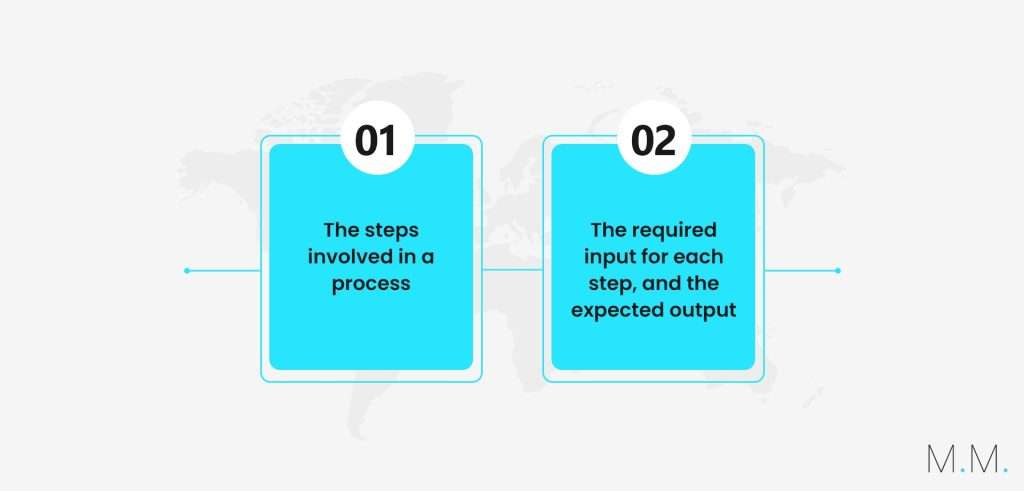
Mapping the as-is process gives you deeper insights into what is happening, providing opportunities to remove unnecessary steps, identify bottlenecks, and better manage your operations. But most importantly, process mapping paves the way to identify and qualify opportunities for automation.
Checklist for identifying RPA opportunities
After mapping out your business processes, you’ll need to qualify them to identify opportunities for RPA implementation. Here are some key considerations to keep in mind.
1. Can the process be clearly defined?
As discussed above, you’ll need to identify clearly defined processes to implement RPA successfully. A process that involves frequently changing steps, or one that lacks defined steps, invites challenges when you attempt to automate it. This is because RPA bots will struggle to replicate the tasks.To give you some perspective, here’s a process with defined steps that RPA bots can replicate:
• Logging into a computer system.
• Loading up one of your software apps (e.g., CRM, order management solution, ERP, HRM)
• Extracting defined information.
• Organizing the information into an MS Excel sheet.
So, similarly, you’ll need defined processes to achieve automation.
Is the process repetitive, time-consuming, and does it require manual labor?
Why is any organization interested in automation? The answer: to drive business goals.
These goals could be cost reduction, improved efficiency, greater productivity, etc. As a consequence of these goals, you’ll need to qualify RPA opportunities by determining their ‘feasibility’. In other words, just because you can automate a process, is it actually worth doing so?
Some considerations you’ll want to prioritize include whether a task is time-consuming, repetitive and if it requires manual labor. If these conditions are met, deploying RPA bots can possibly save your business valuable person-hours and allow you to upskill employees. You’ll free your workforce up from mundane tasks, improve efficiency, and help employees assume more specialized roles.
2. Does it require human intervention?
Requiring human intervention does not disqualify a process as an automation candidate. It could still be automated, but with the help of “attended automation” – i.e., when humans work with RPA bots.
In your discovery process, it’s important to identify which processes may require a degree of human intervention. Then, you’ll need to determine if there’s scope to implement attended automation.
3. Is the task prone to human error, and are the errors costly?
This is one of the most important questions that drive business managers to take up RPA implementation across their organizational processes. And it is, by far, one of the greatest benefits of RPA. Since RPA mimics human actions by using computer programs, it reduces human error, such as data entry errors. Software robots are like digital employees that can carry out a task in the exact way you want them to, without the chance of adding an extra zero or missing out key components.
So asking yourself ‘is the task you are considering to automate prone to human errors?’ is a good way of determining whether it is a good candidate for RPA implementation.
Starting your RPA journey: Best practices
Planning to embark on your automation journey? Here are some important considerations to help you successfully implement RPA.
1. Identify viable use cases for RPA
Constructing use cases is an essential step for any RPA program. For our purposes, we will build a use case based on the following structure:
• Workflow Diagram
An easy-to-read visual representation of a task\’s main steps from input to output.
• Problem
Issues in the task that costs the enterprise directly or indirectly. These vary widely depending on the industry and department but have a few common characteristics, some of them being:
1. Costly in terms of full time equivalent (FTE) – an employee\’s daily workload. E.g., 1 FTE is one whole day of work, while 0.5 FTE is half a day of work.
2. Having a high volume of Transactions (VOT) – the total number of transactions processed in a given time.
3. Long average handling time (AHT) – the average time taken to complete the task.
4. High human error – all those instances where a planned activity fails to achieve its intended outcome.
• Solution
Details of the RPA deployed to solve the problem. These include:
‣ Whether the RPA bot was deployed assisted or unassisted. Assisted RPA is deployed via a server to an employee’s workstation, granting the employee control over when and how the bot is used. In contrast, unassisted RPA typically resides in the back-office and functions autonomously.
‣ The number of bots deployed.
‣ Development time (creating and testing the bot).
‣ RPA vendor.
• Result
The impact on the workflow, e.g., 20% error reduction, 1,000 transactions processed daily, etc.
We will use a telco example where we deal with order fallouts through RPA bots.
Workflow Diagram

Problem
An order fallout occurs due to non-scalable systems, inconsistent data, and incomplete processes. Fallouts result in customer churn, degradation of service offerings, and bad customer experience. In some cases, Telecom operators have implemented the first layer of automation for managing fallouts, but in several cases, fallouts are still being handled manually, even with management systems.
Solution
RPA bots are used to monitor, handle and escalate fallouts in real-time. The bots are trained to handle/resolve the most common exceptions in case of fallouts. If robots cannot understand the fallout, they can escalate the request to the relevant team.
Result
- 60% FTE reduction.
- 70% decrease in average handling time.
- 80% Error reduction
2. Return on Investment (ROI) of high/low-volume processes
A general trend amongst RPA deployed in high volume use cases is using multiple bots for a single process. So when enterprises evaluate the ROI for such use cases they have to factor in the cost of purchasing extra licenses and maintaining additional bots.
Conversely, low-volume use cases will only require one bot. However, this is inefficient in terms of computational power and licensing cost. Here enterprises can maximize the bot’s effectiveness by finding opportunities to use it for multiple use cases, for example, combining use cases that deploy robots during working hours with use cases that deploy robots outside working hours.
3. Target setting metrics for RPA
Measuring the effectiveness of RPA is an important part of its successful implementation. Here is a non-exhausting list of metrics to keep an eye out for:
• Total number of automated processes:
The sum of all processes that have been identified, have developed use cases, and have RPA bots deployed to them.
• AHT:
The average handling time of an automated process.
• Error Troubleshooting cost:
The loss of business value when the RPA bot is idle while being fixed. Also, the FTE required by the support team to fix it.
• Estimated saving:
The capital saved by reducing errors, decreasing AHT, and saving FTE through RPA.
Enterprises just starting their RPA program will find it prudent to focus on the total number of use cases and the number of robots deployed. This is because, without use cases, it’s not possible to deploy bots, and without them, one cannot measure other KPIs.
Troubleshooting errors associated with RPA
According to one study, 30% to 50% of initial RPA projects fail, and one key reason for failure is enterprises underestimating what happens after processes have been automated, including maintenance costs such as error troubleshooting.
However, discovering and diagnosing errors created by RPA bots can be tedious and time-consuming. Fortunately, these errors can be classified into four categories: slow applications, process exceptions, interface changes, and data errors. Enterprises implementing an RPA program can adopt the following troubleshooting practices for these four different error types to improve their effectiveness in dealing with RPA bot issues:
1. Slow applications: bots tend to fail when using slow-running applications. Several issues can cause the poor performance of applications, and thus troubleshooting is often a lengthy procedure. A potential solution can be integrating tried and tested application diagnostic routines into the RPA support function.
2. Process exceptions: A common error is unforeseen process exceptions that the RPA bot does not know how to resolve. This is why it is essential to account for all process exceptions when developing a use case and having a rigorous testing phase. Additionally, the RPA vendor may install a generic exception handler that notifies all relevant stakeholders and immediately ends the bot’s operations.
3. Interface changes: Since RPA bots mimic users, they are sensitive to changes in the application interface – labels, dropdown menus etc. To combat this the RPA support department and the IT department need to have good communication so that bot behavior is in sync with changes to the software interface. Alternatively, a master control bot can be deployed to adjust bot behavior, though this option is expensive.
4. Data errors: when the entered data is in the wrong format, e.g., entering numbers for fields that only accept letters. Here RPA developers should ensure the bot only uses the correct format.
4. Prioritize speed and delay-sensitive processes
Another important priority at the beginning of your RPA implementation program is the speed of delivery and process completion. Look out for processes that often fall prey to delays and setbacks due to lack of automation. Any tasks that could potentially cause a delay in the delivery of services to customers (like fetching order information) or a delay in other processes and the smooth flow of operations (like resolving simple IT requests) are potential candidates for RPA implementation.
While it is natural to want to dive fully into an exciting new area like implementing RPA solutions in your organization, it is important to understand that big wins don’t necessarily come by automating whole processes. It is perhaps wiser to start by identifying the specific tasks where automation can accelerate, streamline, and reduce errors in the overall process. Make automation a gradual process and you will see better gains and greater success on your journey.
Why consider a managed service provider (MSP) for RPA?
RPA implementation requires a great deal of discovery, planning, and successful execution. You’ll typically need specialists to help you discover and qualify viable use cases, facilitate adoption, and successfully implement RPA in your organization.
Since many businesses lack this in-house expertise, they rely on an RPA implementation partner, or managed service provider (MSP), to help them implement RPA. Implementation partners help you identify use cases that offer the most business value and establish a roadmap for implementation.
They typically offer services like:
1. Process discovery: Identifying business processes suitable for RPA.
2. Process analysis: Creating a model of the process which highlights its current issues.
3. Automation analysis: The process model after implementing automation – showing tasks within the process that are to be automated and defining the effects of implementing automation in those regions.
4. Business Case (ROI) analysis: A thorough analysis of the costs and benefits of implementing RPA for the enterprise. The business case acts as a proof of concept and a guide for investment decisions.
If you’re considering partnering with an MSP to achieve your automation goals, M.M. can help you out. We’re a digital transformation partner of choice for leading enterprises, spanning several industries like telecommunications, banking, and healthcare.
Getting started with M.M. is easy – get in touch and let our experts assess your needs.