In 2020, poor software quality cost organizations in the USA $2.8 trillion. Hence, quality assurance must not be an afterthought, but an integral part of the development of software.
As organizations move towards greater digitalization, it can often seem like a huge task that may not get all the desired results. Focusing on features and not that much on quality and providing a ‘wow’ factor can cost you more than you think.
As time and money will be invested and returns may not be immediate, it is worth thinking about a viable plan for the results that are desired and needed for successful digital transformation.
To ensure a great product, what is needed can be discovered through investigations of specific needs and then worked on. Finding out the pain points, what needs to be improved and imagining the ideal solution is the beginning.
After this, a clear quality assurance testing process will take software to the next level. This software solution has to be able to do what it is designed to achieve and the potential to be further developed and improved.
In this article we will look at what manual software quality assurance is and why it is important for you. Organizations that want to take giant leaps into improved digital innovations know that each stage of this journey can lead to both success and failure. The deeper we delve into the process, the better the outcome will become.
What is Software Quality Assurance?
In its simplest form, software quality assurance refers to the process of ensuring that software meets the correct requirements during development. It is also important to check usability, functionality, and performance.
The key work of software quality assurance is to check the quality of the software, deliver a bug free product to clients and make it simple enough to get information or data to the client.
In the process of quality assurance testing, both the client and the end user has to be kept in mind. The client knows what they want but testing needs to be done with a layperson in mind. Someone with no or very basic prior knowledge, who can use the software to its full potential.
How is Software Quality Assurance Carried Out?
Initial quality assurance may have only been viewed as a support function, today it is critical to both business support and customer satisfaction. Therefore, how testing is carried out is vital.
There is an option of manual testing, automated testing or a mixture of both for quality assurance.
Manual testing is carried out by human testers imitating the end user and checking the functions of the software. This is without automation. Bugs can be identified and reported and fixed. The development team and quality assurance team work closely to identify and fix the bugs respectively and then retest to ensure bugs are fixed.
The benefit of manual testing is that the end user is kept in mind and this is the ultimate requirement of a software- its usability.
Even when a client approaches a digitalization partner with a software need, the developers and quality assurance team may well see better options for usability and better quality. This takes software to a higher level of quality and ultimately makes for better digital transformation.
The process of manual testing is given here:

Automated Quality Assurance
Automated quality assurance testing is useful in certain scenarios. Automated testing allows machines to execute test cases automatically. Automated tests are beneficial where software is more stable and developed and when testing repetitive scenarios. For the purpose of stress tests that are repetitive, automation is an ideal and more favored option for quality assurance.
Automation will save time but it cannot completely imitate human use of software. Manual testing has a much wider scope for checking both user interface (UI) and user experience (UX).
In all cases human involvement is required to initiate or complete tests.
In the process of quality assurance testing, testers are a bridge between digitalization and development. This is a key role that takes the ideas from one place and refines them till completion in another.
Benefits of Manual Testing
- Accuracy
Human testers can spot obvious problems and more not so obvious problems. As humans will use the software, it is better to test with the real life users to ensure that all potential bugs are detected.
- Usability Insights
Where automated tests cannot take into account human factors and are unable to provide the best user experience, human testers can offer insight and observations into UX and UI by taking on the role of the end user.
- Adaptability
Human testing is more agile and can be used as changes are initiated. This enables quicker intervention and changes in tests, if needed.
- Cost efficient
Automation requires specific tools that require a higher investment of money to initiate. Manual testing is not such a huge investment. Human testers can be trained for new scenarios as software is updated and this saves on costs.
Limits of Manual Testing
- Human Error
While the end users will benefit from human test scenarios as they are more true to life, human errors are always possible and bugs can be missed.
- Not suitable
Where the volume of data is huge or tests require a heavy load, human tests will not work as well as automated ones.
- Time consuming
Manual tests require time and this can slow down other processes or miss required deadlines. Being dependent on human resources, who have to manage other tasks, manual tests can cause delays in completion. Automation is much faster, where possible.
- Not reusable
Manual tests cannot be repeated- each test case for each application needs to be developed separately.
Types of Tests
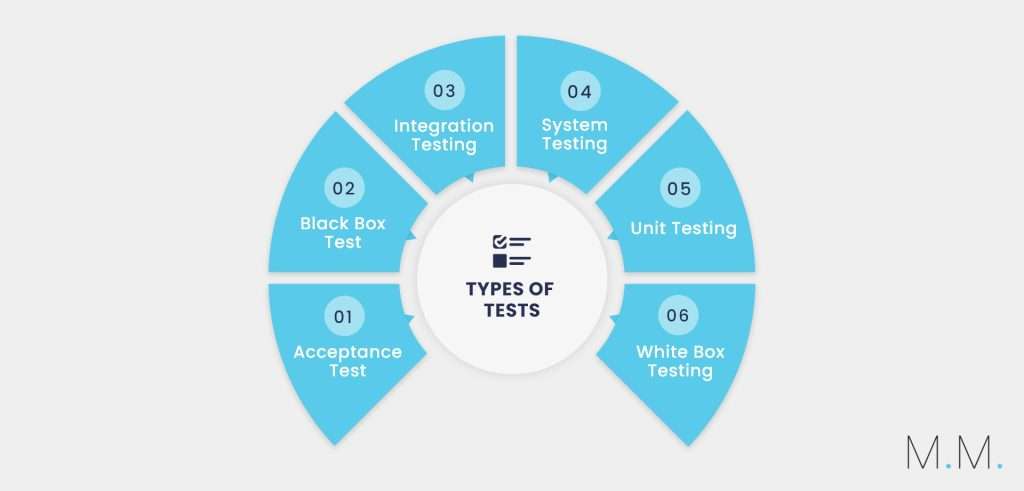
Acceptance test or User Acceptance Test (UAT)
This testing technique is used to determine whether or not the software system has met the requirement specification. In this test, the main objective is to check if the system meets the required criteria for delivery to the end user and evaluate its compliance with business requirements. Typically this is carried out before a product goes to market.
Black box test
This test will check scenarios where the system can break. The test is done without looking at coding or the internal structure of the software. This test is useful to replicate typical user activities. An example of such an input is a password not being case sensitive.
Integration Testing
This software testing is used where different units, modules or components of a software application are combined together for testing. In most cases the components may be coded by different programmers. This test allows combination testing after each unit is tested and can detect faults where integration is not successful.
System Testing
This test allows testing the software in completion. It evaluates end to end system specifications. Typically installation and recovery testing is done in this test.
Unit Testing
This test will check each unit to see if there were any issues in the development stage. It can detect current bugs and prevent future ones.
White Box Testing
Also called transparent or structural tests, this type of testing checks the internal structure, design and coding of software. Tests are used to improve design, usability and security.
Software Testing Needs a Plan and Processes:
The best testing will require documentation as teams work together to develop and improve software. Clear communication and collaboration is also required. Documentation as well as discussions will assist in excellent processes. A document for a “Test Plan” will include objectives of a test, the different scenarios to be tested, resources needed for tests and deadlines etc.

Why Quality Assurance is Key to successful digitalization
Quality assurance will enable an organization to build its reputation as one that offers reliability. It will also ensure the customer is satisfied with the product. It will allow developers to innovate further based on good results or by removing faults.
A detailed look at current quality assurance approaches and what will better aid digital transformation will allow organizations to adopt necessary changes and re-think this process.
Traditionally quality testing occurs at the end of the software development life cycle (SDLC), using the waterfall approach. This limits the speed of development. A better approach would be an agile method of assurance, to test as development occurs. If bugs are detected as development occurs then speed of final delivery is better achieved.
When we think of digital transformation, we also need to think about how each product is aligned to that vision. Digital transformation is not always about complete automation of all activities and here is where quality assurance is more dependent on the human touch. Quality assurance tests carried out manually or a mixture of both manual and automated tests aid digital transformation better.
Final Thoughts
Quality assurance has to become an integral part of the development of software for organizations. It provides a supporting role in digital transformation but is needed to allow for better performance and security.
Keeping the end user in mind primarily and using the most appropriate tests requires choosing a partner for digitalization that has ample experience to aid the journey to digital transformation.
Digital transformation does not mean complete automation of all processes, so selecting the processes that will most benefit by automation in an organization should be examined. Not all processes can be fully automated and quality assurance is one area that will always need human involvement as the main purpose is to see if a software can be used as intended.
Manual tests require patience, creativity and vision, foresight to see problems and solutions for the best usability. Quality assurance that is integrated within software development and viewed as an essential component in digital transformation will assist in an organization enhancing its technological edge.