Chatbots and Robotic Process Automation (RPA) have been some of the key technologies for any enterprise\’s digital transformation. Now that both technologies have matured, enterprises should consider an RPA chatbot combination to take their automation journey to the next level, especially in customer services, where a chatbot RPA solution could transform how customers interact with companies and their products.
Comparing technologies – Robotic Process Automation (RPA) Vs. Chatbot
However, before discussing the combined use of RPA and chatbots, we should first lay a foundation for these two technologies. What are they, and how do they differ from each other?
Chatbots are software that simulates a human conversation through text or speech. There are two types of chatbots; basic chatbots and intelligent chatbots. Basic ones follow pre-defined rules and have scripted responses to user inquiries, while intelligent chatbots leverage artificial intelligence (AI) and natural language processing (NLP) to have a free-flowing conversation with the user. Examples of chatbots include OpenAI’s ChatGPT, WestJet’s Juliet, etc.
RPA, on the other hand, is software that mimics the way humans interact with systems and software, including clicks, keystrokes, navigation, etc., using software bots. RPA platforms like UiPaths Business Automation Platform and Automation Anywhere\’s Automation 360 provide licenses for this technology.
Having clarified that, let us discuss their differences.
Where are RPA and Chatbots used?
Chatbots generally focus on user-orientated queries, where they seek to understand the users’ requests and retrieve relevant information accordingly. A Gartner survey found that 54% of respondents use some form of chatbot, virtual customer assistants (VCA), or other conversational AI platform for customer-facing applications. They can assist customers in resolving their inquiries, tracking their orders, offering refunds, and obtaining feedback.
RPA is used for rule-based, predictable processes. Typically, these are back-end processes where the RPA bot does not require constant user interaction to perform its task. Since it mimics employees on the desktop, an RPA bot can be used for employee onboarding, website scraping, customer order processing, etc.
What are the expected business outcomes of using these technologies?
While there are various metrics you can use to measure the business value generated by a customer-facing chatbot, the focus is typically on improving customer engagement and lowering costs. These outcomes can be measured through:
• The bounce rate: Bounce rate refers to the percentage of visitors who enter the site and then leave rather than continuing to view other pages within the same site. Chatbots can engage your customers by providing them with useful information in an entertaining fashion. Which in turn keeps them on your website longer, decreasing bounce rate.
• Response Time: It is a straightforward metric for how long the chatbot takes to respond to customer inquiries. Chatbots can deliver near-instantaneous answers to simple customer questions compared to waiting for human agents.
For RPA, the main question is, what is the ROI of automating this process? Usually, this boils down to the following metrics.
• Efficiency: This refers to the reduction of time required to execute a process from start to finish after using an RPA bot. A bot can finish more routine tasks in a smaller time frame than humans, reducing the overall time required for a process.
• Person-hours Saved: Person hours is the amount of work done by one person during a specific period. Bots replace workers for routine tasks freeing them for more impactful work or developing new skills.
• Error Reduced: Here, it refers to reducing human error using the bot. Human error is an unintended action or decision. The bot is free from making human errors commonly found in repetitive, monotonous work.
Who is responsible for the decision-making?
Since chatbots deal with customers, the business side champions most of its implementation with minimal IT involvement compared to RPA. For example, an HR chatbot that helps with query resolution, recruitment, and onboarding will need to be overseen by the HR department to formulate these functions and measure the bot’s performance. Consider another scenario with a customer service chatbot. Designing the knowledge base it accesses to answer customer inquiries and selecting relevant customer information to pass on to a live agent require data and experience from the marketing and sales teams.
While RPA requires the business side to find use cases and develop business cases, technical assessment, bot deployment, and implementation are led by IT.
Why you should leverage Chatbots and RPA
Now that we have established a foundation of what both these technologies are and what they are not, we can move on to their impact on enterprises. We will start with chatbots.
Chatbot
A market analysis report published by Mordor Intelligence states that the chatbot market was valued at USD 3.78 billion in 2021, with a projected CAGR of 30.29% over the forecast period 2022 – 2027. They attribute this growth to the demand for messaging apps and corporations\’ rising interest in consumer analysis. Chatbots integrated with messaging apps have a higher ROI, as users favor interaction over their preferred app. In addition, these apps enable the chatbot to store user history to provide a personalized user experience and gain actionable insight.
Chatbots are used in various fields. In healthcare, chatbots are used to help diagnose illnesses through apps like Babylon Health. These bots try to understand the symptoms you enter and tell you the steps you need to take to treat the condition. In this report from Statista on the use of chatbots in the travel and hospitality industry, about a quarter of the companies surveyed use chatbots. About half of the surveyed marketers and IT professionals state that their companies plan to implement chatbot services.
For specific insight into how enterprises leverage chatbots, we will use the example of Amtrak\’s chatbot named “Julie”. Amtrak is a well-known American travel agency, and so it is only natural that the chatbot helps website visitors book hotels and trains. Julie answers, on average, 5 million questions per year, resulting in Amtrak seeing a 25% increase in booking rates and a 50% increase in user engagement and customer service.
RPA
According to Gartner, global spending on RPA software will reach USD 3.35 billion in 2023, with a projected growth rate of 17.5%. The reason for the rapid growth is that RPA vendors are evolving their offerings into more comprehensive automation platforms. These new capabilities include:
• Low code platforms: It is a platform that enables software development through GUI, reducing reliance on coding.
• Task mining: A technology that captures user\’s interactions data (also called desktop data) to analyze and improve their work.
• Computer vision: It is a field of artificial intelligence that trains computers to interpret visuals (e.g., videos, images, etc.).
According to this report by Deloitte, RPA is the most widely used technology to support an enterprise’s intelligent automation strategy (78%). It is adopted by many different industries, such as telecommunications, financial services, and insurance. It can also be used for a variety of business functions, including onboarding new employees, performing regulatory compliances, and transferring data from CRM (customer relationship management) systems to back-office systems.
Again, we will turn to a case study to observe RPA\’s effectiveness. In the case of Telefonica (a telco), they were facing operational challenges in their contact centers due to high labor and IT costs. On the consumer side alone, they needed to employ over 6000 agents to handle hundreds of thousands of calls daily. Blue Prism was used to improve customer satisfaction and call center efficiency. This resulted in:
• 80% reduction in call handling time
• 300% increase in calls handled per hour
• 25% reduction in operating costs in both B2B and B2C within one year ROI
This gives you an idea of each technology’s impact, but now the question is, what is the potential of using RPA and chatbots together?

Why combining RPA and chatbots paves the way forward
Integrating chatbots with RPA enhances the chatbot\’s capabilities so that it can behave more like a virtual assistant. This is because RPA enables bots to access and interact with more software systems within the enterprise. Usually, chatbots can only interact with systems that have API (Application Programming Interface). However, this is not always available because companies have legacy systems, the API does not include a specific function that the chatbot needs, or the system does not have a custom API (because it is costly or time-consuming to create one, or IT do not have resources available).
The main advantages of this integration are:
1. Faster deployment times. RPA does not require extensive backend integration to be deployed and can be used as a substitute for custom APIs for chatbots to interact with backend systems. This bypasses the dependency on IT to develop costly solutions that can take months to deploy and allows chatbots to be deployed quickly and scale within the enterprise. While this strategy is not ideal, it could be useful to organizations that lack the capacity or budget to build custom APIs.
2. Improved information access. RPA allows chatbots to retrieve information from disparate software systems, improving their ability to answer user inquiries. Higher quality information and easier access to data from backend systems enhance customer experience and employee experience.
3. Convenience. In a similar vein, integration allows chatbots to execute menial tasks at the user\’s behest. For customers, this becomes a convenient way to interact with your products/services — for example, a chatbot can help with product selection and immediately enter shipping details on FedEx through RPA. For employees, it gives them an easy-to-use platform to perform routine tasks rather than learning to use every software system, especially legacy systems.
We can observe these benefits in a general use case in a contact center. Routine inquiries by customers, like account information, order status, and billing status, can be handled by chatbots that collect this information from different systems through RPA. This will provide a self-service platform that reduces average handling time (AHT) and improves customer experience. Complex inquiries that the bot can’t handle will be routed to human agents.
For a proof of concept, we can turn to a case study by UiPath, in which it uses its own technology to streamline and enhance employee work life. We will focus on the project that uses a Druid-enabled chatbot integrated with their RPA bots to reduce the IT help desk workload and improve the employee experience.
Employees would describe their IT issue to the bot, and depending on its complexity, the bot would either authorize a robot to fix it or forward it to the IT help desk. In the pilot deployment, the automated IT help desk bot handled and automatically resolved about 15% of incoming requests decreasing AHT by 98%.
The RPA chatbot combination – what lies ahead?
The potential of RPA and chatbot integration will continue to grow as both technologies mature. For instance, UiPath partnered with Druid to integrate their chatbots with UiPath’s platform. Their platform also offers easy integration with other leading chatbots. Other industry innovators like Automation Anywhere are also offering combined solutions.
Another promising development is cognitive RPA which leverages Artificial Intelligence technologies like Optical Character Recognition (OCR), Text Analytics, and Machine Learning to enable RPA bots to handle more complex processes. RPA enabled chatbots would then be able to interact with unstructured data – information not arranged according to a preset data model, e.g, paper documents, email chains, messages, etc. This further increases their ability to provide useful information to the user.
As far as the future of chatbots is concerned, the goal is to create bots that can better understand the nuances of human language to enhance self-service experiences. This requires chatbots that are capable of learning and adjusting their responses from repeated interactions with users.
We can turn to OpenAI’s research paper on GPT-4 as an example of such developments. GPT-4’s style and tone are more customizable by the user than GPT-3.5. When it comes to capabilities, GPT-4 is more reliable, creative, and able to handle much more nuanced instructions than the previous version. The difference can be seen in the image below, where they compare the exam results of both bots.
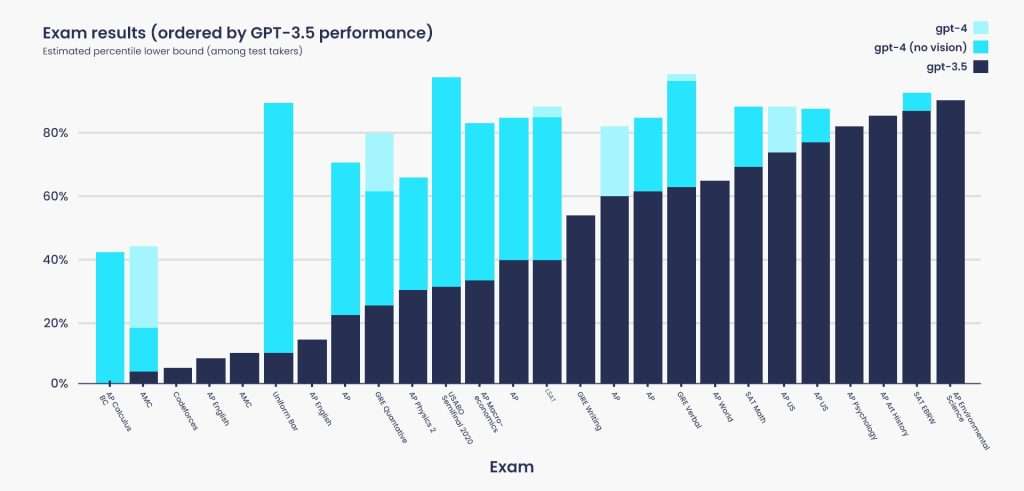
Image taken from GPT-4 (openai.com)
How can enterprises leverage this transformation?
Enterprises looking to leverage these technologies should prepare by being aware of the following:
• Making sure that their preferred platforms for RPA and chatbots can be easily integrated and are simple to deploy and scale.
• When deploying RPA, they should be careful of incurring technical debt. In the context of RPA, this refers to the long-term maintenance cost of bots due to errors such as changes in the user interface.
• Their preferred chatbot has multilingual capabilities.
Conclusion
Chatbots and RPA are already powerful tools that deliver massive business value to enterprises regarding customer services. Naturally, leveraging their combined solution opens new avenues to deal with customer challenges, such as acting as self-service platforms, but it doesn’t end there. Trends like hyper automation are on the rise and more platforms are evolving to integrate different automation technologies, this brings exciting new possibilities for the potential of combining RPA and Chatbots.