As you might have gathered from the name, intelligent automation (IA) is automation with cognitive capabilities. It leverages artificial intelligence (AI) technologies to enhance automation, which means IA platforms also develop in tandem with advancements in AI. In fact, the intelligent process automation industry is expected to be worth nearly $51.4 billion by 2032. If you’re interested in learning about intelligent automation, its capabilities, and what it can do for your business, you’ve come to the right place.
What is intelligent automation?
Intelligent automation is the combination of automation and AI technologies. Here’s more on the technologies involved:
- Robotic process automation (RPA): RPA uses software bots to automate repetitive, rules-based tasks. These RPA bots are programmed to mimic human actions, such as clicks, keystrokes, and navigating, allowing them to interact with different systems and perform various actions that a human can.
To deploy RPA, the process in question must be:
- Rules-based. I.e., it follows defined rules and conditions. For example, in data extraction, the bot may follow rules that specify which fields and information to extract (e.g., by identifying specific keywords).
- Repeatable. I.e., since RPA bots will execute predefined instructions, they must be deployed on processes that have defined, repeatable steps.
- Artificial intelligence: AI provides technology with the means to mimic some aspects of human cognition, and there’s a very broad spectrum of AI technologies covering different focus areas. For example, optical character recognition (OCR) is used to “read” documents, while generative AI creates artificial systems capable of creating content, including video, text, and image.
Intelligent automation (IA) involves equipping RPA bots with AI technologies to make them “intelligent.” Intelligent bots can thus automate tasks that traditional RPA bots require humans in the loop for. Some of the AI technologies that enhance these bots include:
- Generative AI: Unlike traditional AI, which is primarily focused on recognizing and analyzing existing data, Gen AI involves creating data, images and text based on patterns and structures learned from pre-existing data.
- Optical character recognition (OCR): OCR allows IA to “read” text from scanned documents or images, enabling automation of tasks like invoice processing or data extraction from reports.
- Computer vision: This technology enables machines to extract meaningful information from images or videos. Computer vision algorithms can be trained to perform various tasks, including object detection, image classification, facial recognition, and image segmentation.
- Natural language processing (NLP): NLP helps computers understand human language. By training algorithms with human speech and written text, they can interpret and respond to conversations intelligently.
How does intelligent automation work?
Intelligent automation equips RPA – i.e., software “bots” – with cognitive capabilities, expanding the pool of tasks they can execute. You can broadly think of RPA bots as the muscle and AI as the brain, eyes and ears. For example, let’s consider how IA can help organize and validate internal documentation within an organization. AI technologies can extract data from documents, classify them & assign labels, and interpret business insights from the data. The RPA bot can then take specific actions based on pre-assigned business rules and engage humans in the loop where necessary.
Major intelligent automation platforms have already integrated AI capabilities into their offerings, including OCR, IDP, computer vision, NLP, and, more recently, generative AI. This means the bots deployed via these platforms are equipped with said AI capabilities. Leading IA providers also continue to refine their offerings as AI technologies evolve. For example, platforms such as UiPath and Automation Anywhere have recently introduced AI assistants to help users automate their daily tasks with AI-driven workflow automation.
3 Examples of intelligent automation
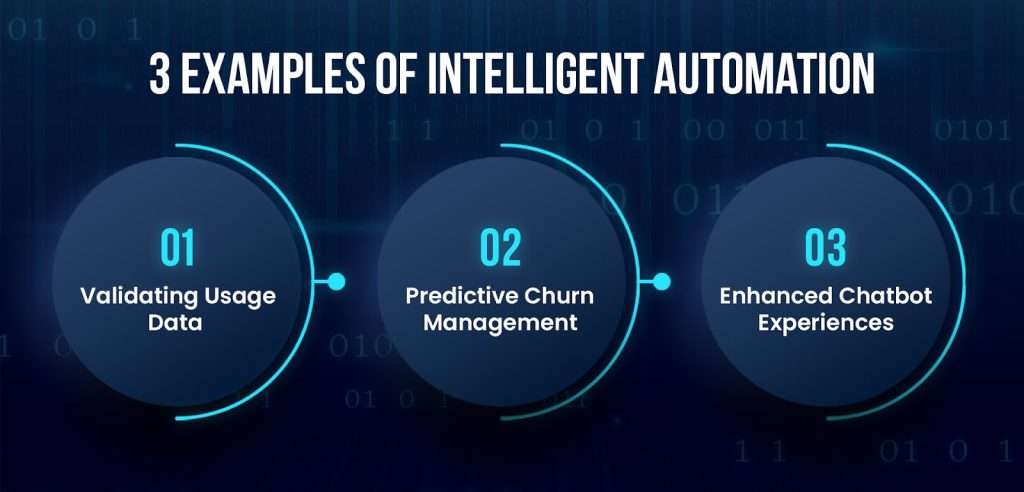
1. Validating usage data
Customer service agents must traditionally navigate multiple systems to validate new product installation dates, ensuring customers are accurately billed. This process involves several repetitive, time-consuming steps that can easily be automated with intelligent bots. Automating the process from end to end can yield the following benefits:
- 85% Error rate reduction
- 56 Reduction In duration/transaction
- 56% AHT reduction
- 82% steps reduced
An intelligent bot can be deployed to automate billing adjustments via API checks, retrieve data from the CRM/CBS and verify account and billing data, determine eligibility based on status and usage, and more. Automating the process from end to end reduces the burden on human agents and improves billing accuracy.
2. Predictive churn management
Unresolved service issues fuel customer dissatisfaction and significantly increase the risk of churn. Predictive churn management leverages intelligent bots to identify potential churn cases and take action to help retain customers. Intelligent bots segment churn cases based on several factors, including the severity of open service requests (SR), the duration of unresolved SRs, and customer sentiments (gauged by analyzing their interactions). The bots then send customized offers to customers at high risk of churning to compensate them, and the bots continue to monitor the service request until resolution.
Deploying this use case helps businesses boost customer retention at scale.
Learn more about predictive churn management here.
3. Enhanced chatbot experiences
An Oracle survey found that businesses can cut half of their yearly expenses by using chatbots. However, deploying chatbots that can satisfy customer queries and deliver personalized experiences can be challenging. Intelligent automation enhances the capabilities of traditional chatbots by helping them perform automated actions and retrieve & update data from internal systems.
For example, if a customer requests account information, an RPA bot can extract these details from the CRM and feed them to the chatbot in real time. The chatbot can then provide personalized services to the customer. Similarly, if human intervention is necessary for an interaction, an intelligent bot can analyze the customer’s previous interactions and request to route them to the relevant personnel.
5 Benefits of intelligent automation
Intelligent automation offers several benefits, some of which are easier to quantify—such as direct cost and time savings or error reduction. These quantifiable benefits allow enterprises to estimate ROI for IA deployment and specific use cases, which is key to securing internal buy-in for an intelligent automation program.
However, IA offers additional value that may be overlooked, such as delivering superior customer and employee experiences. IA programs can also foster a culture of innovation and encourage employees to incorporate technology in their day-to-day workflows to improve productivity and the quality of their work.
Here’s a more detailed look at the different types of value intelligent automation offers:
- Cost reduction. Deloitte’s Global Intelligent Automation survey reveals that cost reduction is a top priority for many organizations, and IA plays a key role in achieving this. According to the survey, organizations leveraged IA to decrease average costs by 24% in 2020, and this figure was projected to increase to over 30% by 2023.
- Improved productivity. A multi-industry survey revealed that workflow inefficiencies remain a major challenge for enterprises, with too many manual processes and convoluted processes or workflows being primary offenders. More than 60% of the survey’s respondents stated that automation is key to making workflows more efficient.
- Better customer experience. Intelligent automation can improve customer experiences in multiple ways, such as by enhancing self-service options, delivering personalized experiences, and reducing the time to complete back-office functions (such as claims processing), resulting in quicker resolutions.
(Learn more about the role of intelligent automation in customer service here) - Error reduction. Manual processes are prone to human error, inviting inaccuracies in data and leading to incorrect actions or uninformed decision-making. Intelligent automation can minimize these errors by automating repetitive, rules-based, and error-prone manual processes. In a survey of over 400 professionals across industries, over 80% of respondents reported that IA helped enhance data accuracy and security.
- Better decision-making. AI can analyze vast amounts of data to identify trends and patterns that might be missed by humans, and RPA bots can quickly relay this information to humans as needed. For example, in the call center, intelligent bots can retrieve customer data from the CRM and pass it to the human agent instantly. These bots can also analyze a customer’s previous interaction history and recommend resolutionary actions to the service agent.
Implementing intelligent automation: what you need to know

If you’re considering intelligent automation for your enterprise, here’s a quick overview of what you need to know:
Vendor selection
While some enterprises develop their own custom IA solutions, most purchase licenses for existing tools that lead the intelligent automation space, such as UiPath, Automation Anywhere, BluePrism, or Microsoft Power Automate. At a minimum, IA platforms should include the following core capabilities:
- Screen scraping, which involves extracting data from an application’s graphical interface without requiring APIs or access to underlying code.
- Task recording, which allows users to record themselves performing repetitive tasks on-screen and convert it into a script that can be deployed. Some platforms have infused AI capabilities into its recording features, allowing users to narrate their tasks to improve the script’s accuracy.
- Support for both types of automation, including attended (automation for workflows involving both humans and IA bots) and unattended (automation that runs without any need for human intervention).
- Orchestration and administrative capabilities to manage users, bots, machines, scripts, configuration, monitoring, etc.
- Facilitates multiple bot runtimes, i.e., the platform supports multiple bot deployments on the same host computer through independent environments, such as on-premise, cloud, desktop, virtual machines, etc.
- Core AI technologies, including intelligent document processing, computer vision, and optionally generative AI.
Some platforms may be better choices than others depending on your enterprise’s size, digital transformation maturity, and needs. For example, one consideration might be whether an IA provider has a strong network of service providers for your specific industry. Other key considerations include pricing, SLAs, and post-purchase support.
Talent and skills requirements
Before an enterprise can successfully implement an organization-wide IA or RPA program, it needs to fill specialized roles. Key roles include IA business analyst, RPA developer, solution architect, and infrastructure engineer. Some of these roles may be sourced internally by upskilling existing talent, although more technical roles, such as RPA developers, are more likely to require external recruitment.
Some enterprises consider establishing an automation center of excellence (CoE), which requires collaboration between business and IT units for success. The CoE also requires additional roles, such as an IA champion and change manager. You can learn more about the required roles and how to roll out an RPA upskilling program here.
Business case validation
One of the most vital undertakings of an IA initiative is validating the business case, which largely entails proving ROI through estimates and distinguishing IA’s value. Accurately estimating ROI requires input from process owners, business analysts, and RPA/IA champions because organizations must first identify use cases and then proceed to evaluate their business value.
For example, automating a back-office function such as claims processing may deliver value in the form of (1) time-savings, as IA bots can execute tasks quickly and in parallel, 2) FTE reduction, and (3) improved accuracy by eliminating human error. Translating these forms of value into ROI estimations can help IA program leaders secure internal buy-in by justifying the business case for IA.
Importantly, some use cases may not yield sufficient ROI and might possibly offer negative ROI. Thus, IA program leaders are tasked with not only discovering viable use cases but also disqualifying unviable ones.
What’s next for intelligent automation?
Intelligent automation’s evolution will be shaped by two core factors:
- Technological developments. As automation and artificial intelligence technologies continue to evolve, the capabilities of intelligent automation will advance by extension. The advent of generative AI is the most recent example of this; IA vendors have infused genAI into their platforms to increase user-friendliness and allow users to deploy new use cases that leverage these capabilities. Core capabilities of IA platforms have also been enhanced with gen AI, such as intelligent document processing and AI screen recording.
- Adoption. As IA adoption increases, enterprises will continue to discover new use cases and improve the efficiency of key processes. Widespread adoption of AI across enterprises will help organizations restructure the way employees work; freeing them up from mundane, repetitive tasks and enhancing their workflows with intelligent assistants.
Thus, while the development of intelligent automation solutions and technologies will raise the bar for what’s possible, enterprises are tasked with discovering the bar itself.