An alarming 30-50% of initial Robotic Process Automation (RPA) projects fail, according to a report by EY. Despite RPA’s potential and numerous successful cases, why does the effort of many enterprises result in disappointment or failure? What went wrong with their projects? In this post we intend to answer that question so that you have a more precise assessment of the major challenges in RPA deployment.
Pre and post-deployment challenges in RPA
Disjointed project success criteria
The first challenge is defining success criteria for your RPA program and communicating them to the enterprise. Problems arise when stakeholders lack proper communication channels to discuss their understanding of the success criteria. This can lead to a mismatch between the business goals and what is realistically possible.
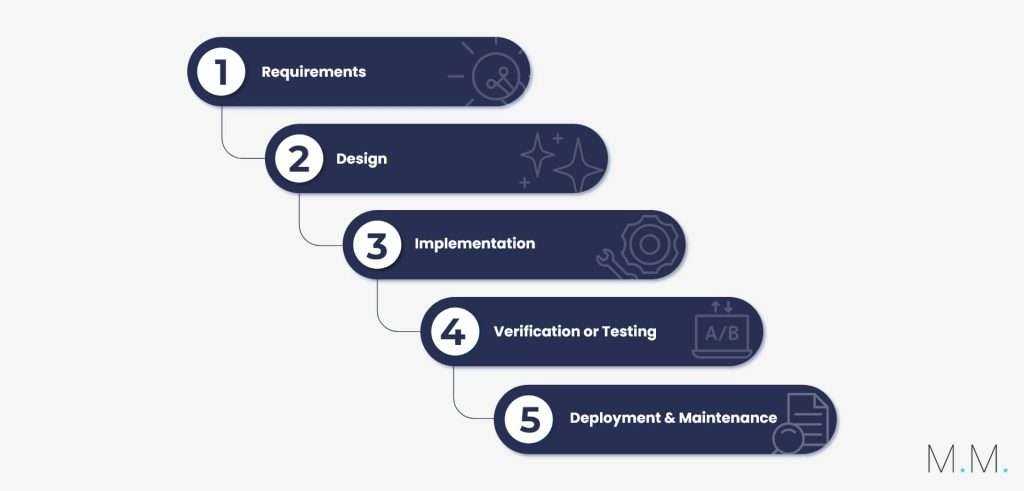
Reference: Waterfall Methodology: Project Management | Adobe Workfront
Abid Mustafa, Chairman of TIAC says: “Typically, RPA activities are undertaken sequentially, which prevents communication and collaboration between different stakeholders.” This waterfall approach (the development cycle is sequential) results in the end user having difficulty delivering feedback. So, any course correction to the set goals will come very late and be expensive to fix. This is why an agile organizational structure with permanent communication channels between all stakeholders is more suitable for RPA.
Agile methodology’s suitability with RPA deployment is due to the technology\’s characteristics and implementation.
1. RPA has a fast deployment time compared to other automation technologies. This is due to the availability of low coding platforms and implementation not requiring big invasive systematic changes that are disruptive to the workflow. This fast deployment time synergizes well with the agile methodology’s emphasis on continuous deployment.
2. RPA bots follow a series of rule-based steps to execute tasks. If there is a software update or change in the workflow, the bot will be unable to complete its function unless its instructions are updated. Agile methodology focuses on iterative changes allowing RPA developers to respond quickly to any updates required to the bot’s script.
3. RPA development and implementation require alignment between business and IT as well as constant feedback from the end user. Therefore it benefits greatly from cross-functional teams promoted by agile methodology.

Reference: How to Break Down Organizational Silos to Speed Up RPA Implementation | UiPath
RPA Center of Excellence (COE)
An RPA Center of Excellence is a centralized group that effectively embeds RPA into an organization. Without a proper COE, there is no centralized body governing RPA making it difficult to reach expected business goals, share knowledge about RPA with other departments, and ultimately scale the program. Therefore it is wise to establish the responsibilities and the members required to create a COE for RPA.
First, let’s outline the primary responsibilities of a COE. Since the ultimate goal is to embed RPA in the workflow successfully, the list should include the following:
• Identify and prioritize RPA opportunities in the business processes of an enterprise.
• Have guidelines and documentation of development, deployment, and maintenance of RPA bots.
• Identify and track key performance indicators (KPI) for an RPA program.
• Ensure communication and collaboration between different departments regarding the program.
• Ensure that best practices are being followed.
• Integrate existing systems and technologies with RPA.
The next question is, who should be a part of the team? Considering the functions of the COE and the nature of RPA, it will be a combination of employees with a business skill set and those with an IT skill set. Here is one template to consider:
• A sponsor who will establish RPA as a strategic priority.
• A member who will drive RPA adoption across the board, being responsible for ensuring a functioning automation pipeline.
• A change manager to let all stakeholders know what is changing and how it affects them.
• Business analysts to identify processes and develop use cases.
• RPA solution architects to define the architecture of an RPA solution and oversee its implementation from conception to completion.
• RPA developers who are in charge of designing and testing bots. They work with business analysts in developing a solution for use cases.
• RPA infrastructure engineers to deal with infrastructure support for server installation and troubleshooting.
• RPA supervisors who orchestrate and manage bots. They will iterate to improve bot performance using analytic tools.
• RPA service support who will be the first responders in assisting with any issues with RPA deployment.
(Reference: UIPATH)
Picking the wrong RPA solution
Since vendors provide you with the platform and resources to develop your RPA program\’s critical capabilities, it is crucial to vet their offerings thoroughly. Otherwise, it can be disastrous for your program in the long run. For example, an update to the vendor’s platform completely breaks your bots’ script forcing you to recreate your entire digital workforce from the ground up.
Therefore considerations should be made on the vendor’s value proposition relative to cost, product roadmap, and regional presence. Beyond this, see if your vendor offers support for:
• Unattended Automation – Unattended automation refers to RPA bots executing tasks independently. Our criteria focus on automating unattended tasks involving data transcription between applications without back-end integration or API.
• Attended Automation – Attended automation is similar to a virtual assistant, which will enhance workers\’ productivity. Here, capabilities like artificial intelligence and machine learning are appreciated for assisting in complex decision-making.
• Enabling Fusion Teams – A fusion team is a multi-disciplinary team where each member uses their expertise to accomplish a business objective. Developers can collaborate easily and quickly with fusion team-supporting vendors, as well as manage the software development lifecycle (SDLC), governance, and automation scripts.
• Automated Document Processing – Automating unstructured or semi-structured data from documents and transforming them into a standardized, structured format for bot use.
• Automation Marketplace – A marketplace for RPA components that are composable, reusable, and serverless which can be exposed through APIs or other means. The market can be used to purchase premade code to build off from and reuse for different use cases to save time and resources.
(Reference: Gartner)
Lack of skilled resources
Seeing the skills required to establish a COE and run an RPA program, naturally, the next bottleneck is the lack of skilled resources. Skills ranging from identifying ideal business processes to technical skills like developing and deploying bots when they are usually not native to most enterprises. So they must either be developed internally or outsourced.
To internally develop RPA-specific skills, it is best to seek certification from proven providers like UiPath, Blue Prism, Automation Anywhere, etc. Their academies usually offer to:
• Teach how to use the platform.
• Develop business analytical skills to identify ideal processes for RPA.
• Enable learning of technical skills in developing, deploying, and managing RPA bots ranging from citizen developer programs that can automate basic tasks to advanced developer programs for complex enterprise processes.
Depending on your circumstances, you can cultivate this talent or hire graduates from the vendor’s academy.
For outsourcing, RPA vendors usually have a support package that can cover deficits in your program. These packages can provide consultancy, technical expertise for bot development, or mentorship for your team. These packages can give access to the available support team or a dedicated expert for your program.
Incorrect process selection
When selecting viable processes for RPA, you’ll need to consider:
1. Complexity, i.e., the number of steps a process has, how many of these steps require decision-making, and how dynamic the process is. Basically, how difficult is it to implement RPA for this process?
2. Business value is the estimated benefits to the enterprise by automating the process, including error reduction, person-hours saved, reduced process time, etc.
A good way to classify business processes according to the above mentioned variables is by making a graph with the x-axis representing complexity and the y-axis representing business value.

Low complexity, high business value processes are ideal targets for automation. They give quick results and are the perfect starting point for an enterprise new to RPA.
Low complexity, low business value processes can be another target for automation due to the low cost and time required for implementation. However, the resultant benefits are limited.
High complexity, high business value processes should be a goal for mature RPA programs. Often they require optimization even before RPA can be implemented and require time to develop a good use case.
High complexity, low business value processes are to be avoided. They are too resource-intensive and have a poor Return on Investment (ROI).
Enterprises may face difficulty labeling processes into the correct categories leading to wasted resources in automating processes with low yield or being bogged down with a complex workflow. Another issue is enterprises adopting the doctrine of automating all processes. Unfortunately, such thinking results in an overall poor ROI, killing the momentum of any RPA program.
For a deeper analysis of process selection for RPA, you can read more here.
Incorrectly identified use-cases
Use cases are foundational for implementing RPA because good use cases allow you to introduce RPA bots and maximize their generated business value. The main challenge is developing large numbers of thorough, enterprise-specific use cases.
An example of a specific use case in the Telecommunication sector is automating Network Entry Reconciliation. Traditionally, field technicians work with customer service representatives (CSRs) to update network changes and, in parallel, work with the provisioning & activation team for order completion. Often, these network changes never get updated in inventory management systems causing data integrity issues. RPA bots can monitor changes in Network Inventory (Master Data) and update the downstream systems in real-time.
Issues arise from:
• Incomplete workflow diagrams, a lacking workflow diagram makes it more difficult for all stakeholders to understand the business process, especially complex processes.
• Missing essential process steps, these steps act as a guideline for the bot; if there is a missing link, the bot will be unable to complete its task.
• Not accounting for exceptions that result in alternative workflows. Use cases should account for anomalies that require a different sequence of steps to successfully execute the process.
The result is that the RPA bot fails to perform its tasks and returns errors, which the RPA support team then needs to troubleshoot. Ultimately it leads to a loss in the potential business value generated by the bot and the resources used to fix it.
Another problem can occur when use cases lack defined business rules for the different types of data being processed by the bot. This causes data errors and becomes another burden to be fixed by the support team.
RPA Training & Employee Upskilling/Reskilling opportunities
Due to RPA technology being easy to use, especially with low-code platforms, enterprises may fall into the trap of only training their business users for a day or two. Minimal training can create issues when developing complex use cases, optimizing processes, or causing constant break-fix cycles due to poor code.
An example of the time investment required for RPA, we can look at UiPath’s courses. UiPath offers a citizen developer course that can be completed in 13h and will allow you to automate everyday tasks. However, their basic RPA developer foundation program (designed for enterprise automation) alone takes 38h 25m to complete. And if you see their other programs for further specialization, it becomes apparent that more than two days of training is needed to build a scalable enterprise-wide RPA program.
Considering the time required to build a strong foundation with the technology, an ideal training period would be two to three weeks of classroom training, followed by two to three months of on-site project delivery with supervision.
Regarding the skillset, enterprises that focus on building the following skills tend to have a more resilient, scalable RPA program—identifying, quantifying, prioritizing, and mapping new processes that need to be automated are top priorities. After that, solution design, programming, and execution are other areas to educate your employees. And, of course, training to monitor and maintain bots.
Security
With every digital transformation initiative comes new security challenges, and for RPA, the main security challenge revolves around sensitive data leaks. These leaks occur due to RPA bots handling sensitive data (e.g., customer information) between different systems using different accounts and credentials given to them. If these accounts and credentials are left unsecured, they are vulnerable to cyberattacks that can access critical systems and leak sensitive data.
Enterprises wary of data leaks may assign a unique identity to each RPA bot and process along with two-factor authentication for the accounts. Another suggestion could be to restrict the bot’s access to only what is necessary to perform its function. In case the security measures fail, and the security team needs to review logs, best practice is to store them in a separate and secure location for the investigation.
Post-Development Support Model
Maintaining a sustainable ROI for your RPA program requires a post-development support model. The job of this support team should be to deal with any changes or issues that crop up after the bots go live. This team should be capable of supporting the program from Levels 1-3.
• Level 1 (L1) support refers to basic tasks like scaling up/down the number of bots, resetting passwords, bot maintenance, etc.
• Level 2 (L2) support is for more technical work, like making minor changes to bot workflows due to additional data or dealing with exceptional workflows.
• Level 3 (L3) support is reserved for significant changes that require deep analysis. These would include an overhaul to workflow or architectural changes.
For the team to have such capabilities, it is crucial to have a dedicated team of RPA experts. These experts should have access to all documentation developed during the production phase, especially documents detailing troubleshooting or restarting the process if it stops during execution.
Final Thoughts
In conclusion, implementing an RPA program can offer significant benefits to businesses in terms of efficiency, accuracy, and cost reduction. However, it is not without its challenges. From selecting the right processes to automate, to ensuring data accuracy and integrity, to building a robust governance framework, there are numerous roadblocks to overcome.
However, these challenges are not insurmountable. With the right approach and mindset, businesses can overcome these roadblocks and implement an RPA program that delivers real value. Key to this is being aware of these challenges and having a plan to tackle them preemptively.
Also, it is also important to acknowledge that RPA implementation is not a one-time event but an ongoing journey. As the business environment and technology continue to evolve, businesses need to continually adapt their RPA programs to stay relevant and effective. With a long-term view and a commitment to continuous improvement, businesses can unlock the full potential of RPA and achieve their strategic objectives.